
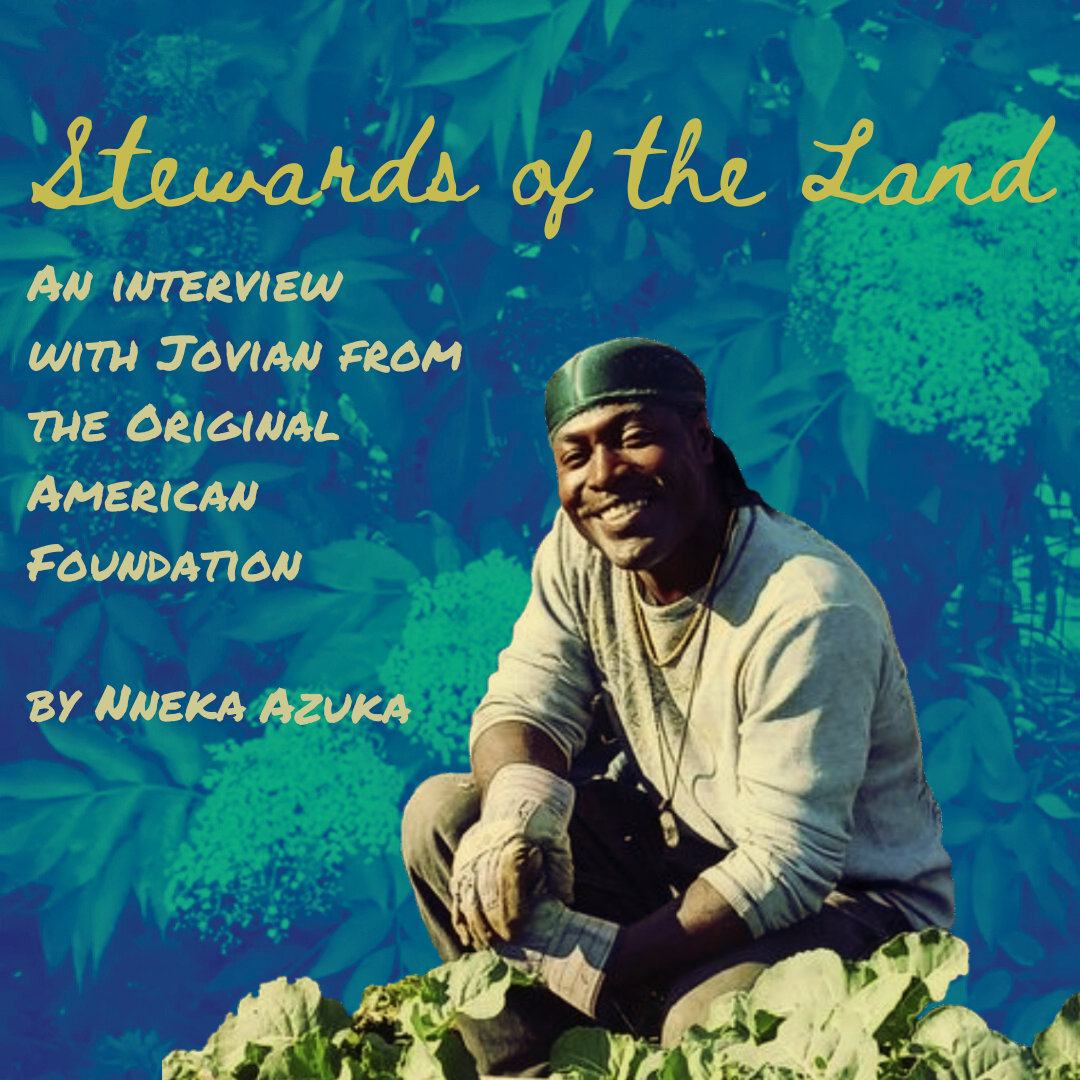
By Nneka Azuka
The Original American Foundation Garden is a community garden project started by Jovian & Robert in 2020, two friends native to the Kingsessing area in Philadelphia. They started the garden as a way to fight back against the gentrification they saw slowly creeping into the neighborhood they called home. In this nook of the city the garden serves as a beacon of hope and aims to educate and provide for the community through the work it carries out.
In our interview with Jovian, he shares his personal experience of witnessing gentrification in his neighborhood and how he has found a way to turn a few of the last remaining plots of green left in the neighborhood into a place that both brings the community together and honors his ancestors.
This interview was recorded in February, 2024.
Nneka: Okay, so tell me about the history of OAF. What’s the story and where did you get the idea?
Jovian: So basically, this was my block. I grew up on the same block that the garden is on. And, you know, I left, I went into military. I want to say in like 2002/2003 I went to military. And when I came back–I would come back every couple of months–it looked like the block was looking different. There was a couple more houses missing. It was a couple more people that moved away or died or whatever. And so when I finally got out, I noticed that the entire block was different. Most of the houses was torn down or abandoned. At the time, the area that’s the garden now was like a horse stable. The basketball court area was just like tore up. So, you know, that’s pretty much how it was.
And just seeing it like that—I just wasn’t feeling it. I didn’t like the way it looked. I didn’t like the fact that we knew that the place was gonna be gentrified in a couple of years. I want to say it was Penn [that was the root of these changes]—we started noticing that the landscape started changing a little bit. The first thing we started noticing was the streets signs started getting updated and stuff like that. And when the street signs started getting updated, we knew that they was trying to improve—so called “improve”—on the area. And it was just a matter of time before it came on that block. And usually gentrification equals people getting pushed out of their homes, taxes going up, rent going up, and people can’t afford to live there anymore. So we figured they, “the powers that be”—whether it was corporations, the government, whoever—not only did they buy up empty houses, but they also bought up empty lots. So we devised a way to utilize them. We figured if we can get the lots and use them in a positive way, then whoever would come through and help gentrify the neighborhood wouldn’t be able to get them.
And around the same time, I started doing my genealogy. I started searching into my family history, and I seen that a lot of my ancestors was like farmers, sharecroppers, businessmen, and stuff like that. And I wanted to use that ancestral energy, like “okay, what will be one of the best things I can do to help the community and something that feels just right to be doing?” And I have a background in the medical field.
Nneka: From the military, right?
Jovian: Yeah, I started when I was in the military. I was a Navy corpsman for like six years, and then when I came out, I worked at different research facilities.Then I worked at Drexel Dermatology, and then I worked at CHOP adolescent initiative, helping kids with HIV and stuff like that. And just growing up just taking care of a lot of my family members. That’s just, you know, my nature.
So I [found] a way to combine everything above into something that I love to do. I always wanted to make sure it’s something I love to do, so it don’t feel as much like working. And I wanted to kill so many birds with one stone—I didn’t want to work for nobody no more, I wanted to help the community, I wanted to be able to help my family, I wanted to be able to honor my ancestors, I wanted to be able to stop gentrification, so I found a way to do it. And the simplest way to do that was just starting OAF. And my partner Robert, he grew up around the corner from where the garden is, on Violet Ln, and he has a similar story, almost exactly. I think the only difference was he didn’t go into the military, that was one of the main differences—almost everything else is exactly the same. We’ve both got similar mind frames, we grew up together and basically that’s how it started. That’s pretty much the story cut and dry.
Nneka: I think all that is really cool. I guess my next question is, do you feel like the garden has made moves towards your goal? Do you think it’s stopping the gentrification in the area? Do you think it’s working? And if so, how? What’s the strategy behind what you’re doing now? And, like, do you think it’s effective? Do you think you should continue doing the same things you’re doing or do you think you should change them?
Jovian: I think it’s working on the scale that we put it out for initially. It’s working because, at least the plots that we’re on, [are] not going to be used for anything else. And it’s about, I want to say, 12 plots all together that we’re utilizing through OAF. And [there’s] a couple more that’s not on the exact grounds of the garden that we still utilize to stop from those things being gentrified. The plots that we used we definitely stopped those general plots on Allison Street from being gentrified, it’s just what we want to improve on is just expanding it. Expanding it from Allison Street to the other blocks in the Kingsessing area, maybe all the way down to Chester Avenue, down to Gray’s, as far as we can reach. That’s like the goal, to stop gentrification in our general area, that small block radius, and then just to reach out to different blocks in Southwest and get more people aware of it. Get more people involved with land stewardship.
[There’s also] this whole thing that went on with the land bank, so [we want to] try to get them back involved. I’ve been trying to reach the land bank for about three months now. They haven’t emailed me back. The only time they emailed me back was about the the resolution sheet, and the resolution sheet is a sheet that’s telling us exactly what land plots we have control of through them. And that was it. After that I was hitting them back about other areas in the surrounding blocks, like 56th Street, or the ones on Vogdes Street. They didn’t hit me back. And they also put on their website that they’re not accepting any applications for land plots for public interest. So I’m not sure what’s going on with that.
One good thing we did get from the City Council and the City of Philadelphia—they did buy back a lot of the liens that were on a lot of properties that was owned by a bank called US Bank, out of New York. And I think on Allison street, not including the ones we already got, I think it was like 22 [bank liens]. The councilman Jamie Gauthier announced that at Iglesias Gardens sometime last year so that was major, but the thing with that is even though they bought the liens back, it was still some tax liens from the city that was associated with them. And those land plots, to my knowledge, aren’t currently under the control of the land bank. So that’s kind of a dilemma. So I’ve been working with the Public Interest Law Center and they tried to find out different ways to acquire that land other than the land bank, so that’s definitely a plus. And we’re going to be having events where we teach people in the area about stewardship, try to get more people out in the area to learn about land stewardship, keep that area how it is–and if it’s beautified, it is beautified under OUR control.
Nneka: What are your additional goals for the OAF? Where do you see the org like in two years and in five?
Jovian: So the goals in general are things we spoke about—being stewards of the land, teaching other people how to be stewards of the land, expanding what we have now, expanding to be able to grow more produce, expanding our general capacity, expanding to more sitting areas, shaded areas, areas to hold events. We want to put a stage out there, we want to get more of the surrounding land plots, to open it up and then bring those land plots together. We want to start holding more events—stewardship events, we [also] want to do networking events because we’ve been able to develop so many different relationships, from the Public Law Trust to Philly Socialists to Iglesias Gardens to the People’s Kitchen to the City Council to Black Farmers Group to Indigenous Education to Mill Creek, Deeply Rooted, the USDA, so many different organizations and people that we get involved with, and a lot of those people should have access to each other and we can be the catalyst to bring everybody together. And we’re thinking about holding multiple different events so everybody can get together and do networking, and also network with the community to see that it’s just not like a flash in the pan type thing, it’s not just like some guys out there just growing food. It’s really a whole community and a big movement going on.
So yeah, that’s what we want to do, to expand and bring different aspects into it. And ultimately, I want to have a farm. I want to have an urban farm within the city limits. I’ve been working to do that. I was trying to put it in Cobbs Creek. The two land plots that I was looking at, they turned it into some kind of bird reservation. So I was looking at some other places out in Eastwyck where it’s just a bunch of open land. Not sure if it’s city [owned]. And one thing that I didn’t know [prior to my own research] is that [there is] land that’s owned corporately, land that’s owned privately, land that’s owned by the city, land that’s owned by Parks and Rec and land that just nobody owns. I did not know it was land like that that still exists in the city. So I’m thinking it’s a lot of land like that down there in the Eastwyck area which is still within the city.
So I’m looking at that land too, to have like a full fledged farm, I mean like a state of the art farm with animals, crops, orchards, the whole shebang. That’s one of our long-term major goals, to have a farm and also to develop our own OAF products. Everything is going to be all natural, it’s going to be products that are not as processed, like smoothies, cut up vegetables, and just straight up vegetables. And then I want to have products [made] out of the stuff we grow like oils, garlic powder, onion powder, seasonings. I know how to do this stuff, I just got to be able to do it on a larger scale. So making oils, making seasonings, making stuff that needs to be a little more processed, spaghetti sauces, pizza sauces, even down to like selling straight up food. That’s my goals in general. That’s the next goals. And that spans from the next two years to beyond. There’s no limit unless something happens. And I want to pass it on to the generation below me.
Nneka: My next question touches on something you mentioned earlier about the issues with the land bank and land ownership. What are your main challenges with the garden in terms of bureaucracy, and with having to contact different entities in order to track down ownership? I know at one point you had told me the story of having to dig through deeds and deeds and deeds to contact somebody who owned a plot of land. Could you talk a little bit more about that process and related difficulties in general with OAF, and challenges you experience more broadly?
Jovian: That’s one of the biggest things—for lack of a better word the “real estate” side, the ownership side. Who owns what, who has the rights for this and the rights for that.It’s legal issues basically. One barrier is—okay, so some of the plots on the garden we have through the land bank, some of the plots were owned privately by people who are most likely deceased now, and also a couple of plots are owned by some folks that are still alive. [Those folks] have general control now over some of the land plots on our main garden. That’s a big one. Been working with the Public Law Trust to try to find different ways [on how] to get the land that’s currently owned by someone who’s living alive and well and paying taxes on it, versus someone who’s deceased [with] no heir stepping up, the taxes is overdue and stuff like that. So that’s a really, really big barrier. Because it seems like a lot of people that we deal with know about it, but don’t nobody know exactly how to do none of this stuff. Like when I talked to the Public Law Trust folks, they understand that some land is owned by a particular person, but other than straight up buying it off that person, they don’t know a lot of ways to try to acquire the land. They said we need to contact City Council to see if City Council has any answers. There’s things called land swaps, [for example]—stuff that [Public Law Trust] might not know about, but City Council might know about. And then there’s other aspects—land that’s owned by folks that are passed or just abandoned the land, [there’s] ways that you can do I think they call adverse possession. And things of that nature, like if—
Nneka:—they’re not maintaining the land, or if they’re misusing it for whatever reason?
Jovian: Yeah, that and if we’ve been occupying it for a particular amount of time, we can petition the city to take ownership of the land and acquire it and pay the taxes off. And then you got tangled deeds, where they’re not sure exactly who owns the land, [or] liens were bought from the land bank, but the land is still owned by somebody because it was sold in 2021 and stuff like that. So it’s a lot of gray area when nobody is really exactly sure what to do. So that’s probably the biggest challenge facing OAF right now as far as land.
Another challenge we have is funding and staffing. We do get grants. They’re small, but steady—we get them like every couple of months. And they do what we need them to do. But as far as expansion, that’s one of the biggest things—like, getting the actual big ones. And then when we do get the big ones, we need more staff to not only handle the funds but to handle [building] the things that we want to build, and expansion—we need people to fill the shoes.
So yeah, that’s probably the biggest challenges that we face right now. But I’m looking forward to facing them, like that’s part of the fun, so we’ll see.
Nneka: So I’m going to try to pivot into talking about staff and the people since you brought that up. How long has OAF been around?
Jovian: Since 2020.
Nneka: So about four years. So how many people have come in and out of the project? How many people are around consistently? What do you think are some of the barriers to entry for people to get involved in the community especially?
Jovian: Oh, it’s hard to put a number on it. But I will say most of the people that helped out have been really consistent. When we need it, they are there. There’s been a lot of family that’s been helping on and off and they’re pretty reliable. Like if it’s not one it’s the other. Philly Socialists has been really good. Iglesias Gardens has been really good. These people are reliable. The People’s Kitchen, Ben Miller [from the People’s Kitchen], they’ve been really good, from advice to literally coming out and helping [doing] volunteer work, or just going to events together or just supporting each other on social media. So it’s been a lot of people who have been there and everybody is there consistently when we do need it. Like we don’t reach out a whole lot, but when we do reach out we really need it and then nine times out of ten people are there so I can see that the network that we built, and the community that we built, like people are there, even some people in the neighborhood—I think that’s the biggest thing we have is just people around the general area. Except when we do events–when we do events, of course people pop up. But just when we want [to ask them] “hey, you want to come help us in the garden,” it’s crickets. I feel like some people just don’t know that we want these things even though we put out flyers and stuff like that.
And that’s why I wanted to start having more events—to just announce these things, draw people out, everybody likes to eat, everybody likes music, so have the different networking events that I was talking about and just general food giveaways at the garden. We’ve done food giveaways at the headquarters that have done really good when people came out, but we haven’t done a lot of big food giveaways other than when we harvest. We haven’t done big food giveaways with outside products at the garden, which I think will bring a lot of people out. And then we can announce some of these things there when we get people in bigger crowds and stuff like that. So just more community participation, but as far as our partners and people to help do the work that are already organized, [that’s] great. It’s just more of the community to help with the garden in general that we need to work on.
Nneka: So it sounds like the people who are in organizations—Iglesias Gardens, People’s Kitchens, Philly Socialists etc.—they’re really good about showing up. As far as the community goes, what do you think is the biggest challenge to getting people out to volunteer?
Jovian: Finding ways to communicate with the people to bring people out in bigger numbers.
Nneka: So you think it’s a communication issue?
Jovian: Yeah, basically, communication, finding ways to communicate with the people in the neighborhood other than like, flyers—because we do flyers, we do door to door, we do word of mouth and stuff like that. It kind of works, but what I noticed with a lot of people in the neighborhood [is that even though] every once in a while you’ll find somebody that’s super interested just because their grandmom gardened or they always want to learn how to garden, your average person is just like “okay, that’s nice,” but they keep it moving. But I think if we have events where it’s like a big thing like this extravaganza and it’s all focused on the garden, I think people tend to listen more when it’s when it’s some free stuff being given away and you know, when people see a bunch of music out there and it’s “oh my god, what is this?” And they’ve been looking at this garden for who knows how long. But when that attention, that super big spotlight, is brought on to it, I think people will want to be more involved.
Nneka: Can you tell me about a recent project specifically that you’ve worked on? Do you have anything specific?
Jovian: So the most recent thing we did—it wasn’t at the garden because right now it’s the winter months and it’s not too much going on at the garden. But we do still have our minds and our bodies and our knowledge. So basically, what we did recently we linked up with the Black Farmers Coalition in December of last year and we went down to Penrose Elementary School. And it was basically an event for the Black Farmers Coalition. It was a bunch of different things going on out there. We had people vending jewelry, we had people vending art. We had a guy by the name of Levi, who is the lead gardener for the Mill Creek Garden, and he had a hydroponics display showing folks how to grow seedlings and crops using hydroponics and [for] OAF, we had our set up, you know, more traditional. We had our soil out there in small cups. We put the seeds in there, we gave them a tutorial on how to grow them and passed them out to whoever came. It was younger kids, it was older kids, it was just normal adults and also seniors. So anybody who came past, they got a little tutorial on how to sprout the seedlings that we gave them and also some knowledge about the OAF in general and what we’re trying to build with the Black Farmers Coalition. So that was a pretty good event. And it was good to be able to spread and that was also down there in the Eastwick Area of the city, so that was kind of cool too.
Nneka: What do you think you learned and how do you think OAF can build on something like this going forward?
Jovian: I’ve definitely learned that if people are passionate about what they do, it will work. Because I’ve seen in so many situations [where] it can be, sometimes two people, they can’t get along and get something to work properly. But—I don’t care how many people it is—if everybody is motivated and dedicated to get something done, it can definitely work. Because with that event right there, I want to say it was about 10 vendors–and [that’s] not counting the people that was just doing demos and just giving stuff away, [that’s just the] vendors that were actually selling things. It was about 10 vendors, Levi doing hydroponics and OAF doing the traditional seed starting, so that’s about 12 different entities, and we [also] had like the leadership so that’s like 13, 14 different entities coming together on short notice. I think we started putting that together maybe a month earlier and it came together just like that. So people motivated and dedicated can definitely get it done. I think that’s one thing that I’ve learned, that if everybody is motivated and dedicated, it shouldn’t be nothing that can stop it.
Nneka: Cool! So let me get broad now: what’s one inspiring story from your work in the past few months, or what’s the coolest story you have so far in the work that you’ve been doing?
Jovian: So, I wouldn’t say I have a particular story. It’s just like everything. Like everything about what I’m doing, every time I see a kid’s eyes light up when they see dirt, or when my son, who out of the blue just didn’t like his vegetables, when he pulled some spinach straight from the garden in the back and ate it and then he was just so happy and then asked for more. And the same thing with tomatoes and he said that tomatoes taste like candy—the ones that we grew. Stuff like that.
Or when I see somebody that I might help [who] wants to start a business and I go over some basic things about starting a nonprofit or I hook them up with a grant or I help them write a grant and they get it. Just everything about it. Helping people in general is what motivates me, and being able to create this entity, or even without the OAF, just the garden in general and being able to help people and see people being happy for something that I did. That’s what inspires me every day, especially in the OAF.
Nneka: What are some failures that you’ve learned from and are there any challenges that you’ve learned from as you’ve gone through this process?
Jovian: So, I would say the best learning moments, or teaching moments, have just been [about] communication. That’s one of the biggest things, especially in, like I say with quotation marks “business” but it goes across the board, just being able to just properly communicate and clearly communicate and make sure everybody is on the same page and know what’s going on moving forward. So that’s a couple of things that have kind of gotten away, bad communication, miscommunication, leaving stuff out, stuff like that can lead to disruptions in the feng shui for lack of a better word, just getting the flow. If people don’t properly understand they might do things wrong or just misinterpret things.
So definitely communication and definitely planning. I’m big on planning and you know, sometimes when you don’t plan stuff properly, it don’t work out properly. Sometimes when I just fly by the seat of my pants, a lot of times it never works. But all in all the main thing is not having proper communication. That has jammed me and other people up so many times, so if it was one thing I would say that.
Nneka: What would you say to people trying to get into a community garden? What advice would you have if you had to do it all over again?
Jovian: One [piece of] advice I would say is definitely plan. “Definitely plan,” I mean, again, is generalized, with anything [if] you plan for it you probably are going to get the best results. But specifically with gardening, and this is kind of generalized too, you have to like it, you have to love it. You have to at least like what you’re doing. Because you’re not going to put your best foot forward. I mean, some people can do that. But most of the time, you’re not going to put your best foot forward if you don’t actually like what you’re doing. And get involved with the community first, get involved with other people that you know are gardening or other organizations, or definitely study it, because some people think it’s just as simple as “put a seed in the ground”. Sometimes it is, but you will see very fast that a lot of times it’s not. Sometimes it’s just simply putting the seed in there and watering it, but it’s a lot more to it than that. So just understand what you’re doing, have a real passion for it and definitely plan.
Nneka: What are you currently working on with the project? I know you said it’s grant season–is there anything else?
Jovian: Currently just working on starting seedlings. I have some containers and some grow boxes, but [they’re] kind of outdated, a little beat up. So I have been ordering the supplies I need to start my my seedlings, and [I’m] trying to figure out exactly what seedlings I want to plant [and] how I want to break down the seasons, because one thing that’s kind of cool I think as a gardener is you have to see the future—and in a lot of different professions you do this too, but here you have to specifically forecast what you want to do most of the time. So especially if you want to get 3 seasons of growth and a lot of things that you grow kinda are cross season. So just prepping that and I’m really excited about prepping a lot of dwarf trees. It’s something new but I’m planning on planting a lot of dwarf trees so I’m trying to line up exactly where I’m gonna get them from, which ones I’m going to get and where I’m going to place them.
So definitely a lot of planning on expansion and getting my seedlings started. I’m just really excited on starting this year. And I think spring is the new year. That’s an indigenous thing—spring is considered the new year because it’s when everything comes to life in nature. I know [in] Gregorian calendar style January is the new year but most indigenous people figure the spring is the new year because everything comes to life, the butterflies are flying, the flowers are blooming, so I’m excited for that.
Nneka: What kind of support do you need from Philly Socialists and what kind of support do you need from the broader community?
Jovian: From the broader community, just participate. And when I say the broader community I mean right now just generally Kingsessing and the surrounding area. We just need more people to come out and just check us out. And you know, get dirty with us, man. Like, come get in the dirt, get your hands dirty, get some of that nature love. Gardening is very therapeutic—you out there, you’re moving soil, you’re planting seeds, basically you’re bringing a light into the world, and to be able to bring light and then have that light sustain you at the same time, there’s nothing like it. Especially when you grew it with your own hands. So just get out there and experience it. It CAN be for everybody. If you do it and you find out you don’t like it [then fine]–which I doubt, most people at least like it a little bit. So just come out and try it and get with us on our social media tags. And that’s for the broader community. For Philly Socialists? Philly Socialists is awesome. I can say that. I’m telling you.
Nneka: My final question is, what do you want the people of Philly to know about? Or like, if you had one or two things or a sentence that you could say, what would you say?
Jovian: I would just want the people of the city that know that Original American Foundation is here for the people. We are. I know it sounds cliche, but we are for the people by the people. We want to see people being self-sustainable. We want to see people being able to grow their own food, save some of their money. We want people to be able to own and steward land. So in one word, we just want to see self-sustainability. That’s pretty much what we’re all about. And come check us out.
Nneka: All right, thank you so much Jovian. This was great. This was really great. Thank you.

 The Philadelphia Partisan