
By E.B.
As US society continues to reel from life under a fascist regime, many turn to the forefathers of socialist theory for guidance on how to continue.
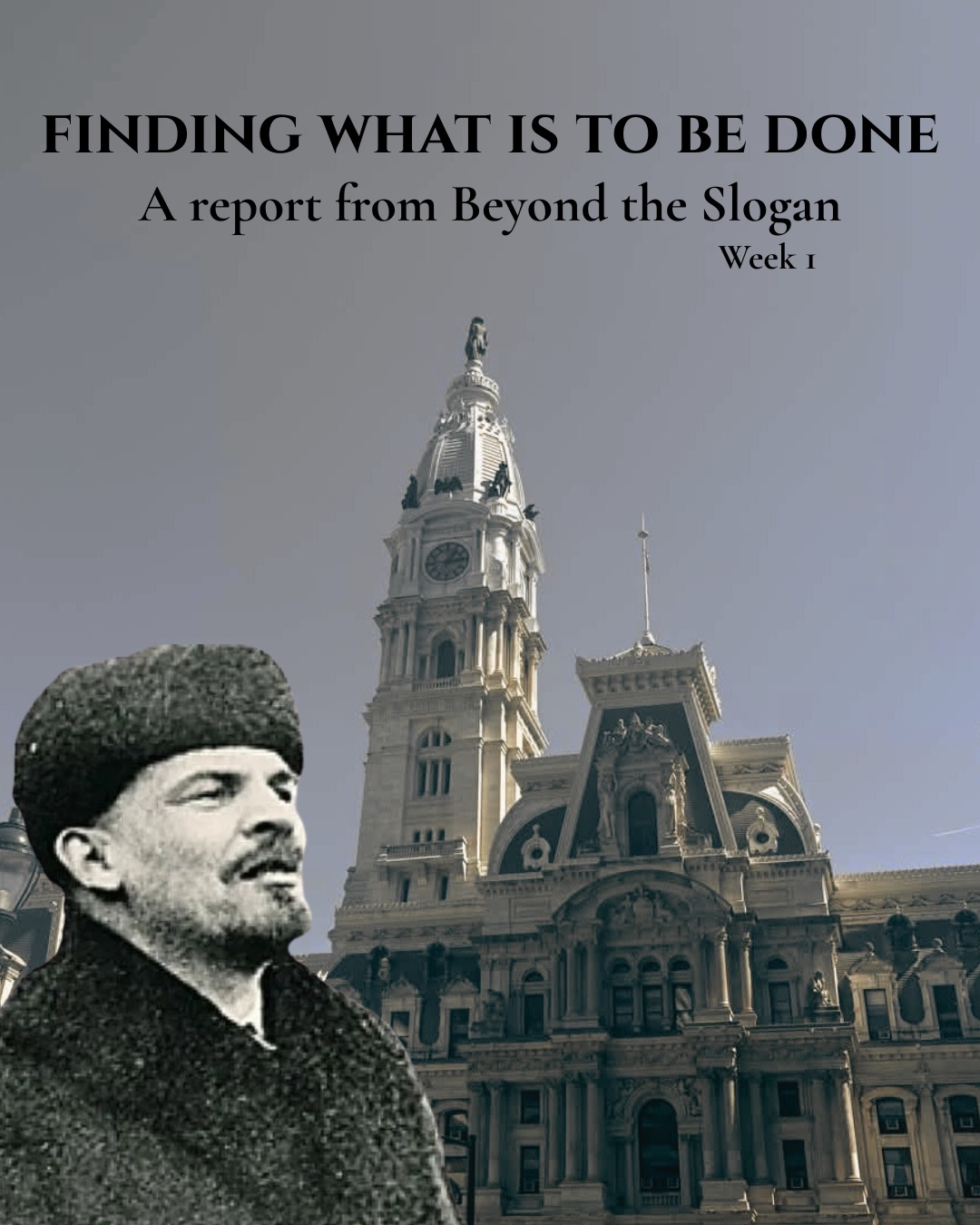
On Saturday, April 4, a group of aspiring scholars gathered in the basement of Wooden Shoe Books for this exact reason. We were about to begin a weeks long dissection and reflection of Vladimir Lenin’s “What is to Be Done?,” with translation and commentary by Lars Lih. Our collective filled the room comfortably; some sat on a menagerie of chairs; others perched above on the stairs. The crowd was diverse: from PS leaders to new faces, Lenin lovers to haters, theory-heads to neophytes, we were all eager to dive into discussion.
The meeting marked the return of “Beyond the Slogan,” Philly Socialists’ reading group. “What is to Be Done?” was selected by vote after the 2026 Winter General Assembly, beating out “Pedagogy of the Oppressed” by Paulo Freire by a tie-breaking decision by the Chairs.
Our first meeting had no assigned reading; it was an introduction to the reading group and allowed participants to share what they were most excited to learn or discuss in the coming weeks. Facilitators took time to discuss the logistics of the upcoming sessions and the reading itself. We centered ourselves on two main goals from the BTS curriculum: first to discern lessons on revolutionary strategy to aid the overall mission of Philly Socialists, and to compare the text to the current political climate to gain understanding of revolutionary consciousness, political organization when illegal, and the role of theoretical debates in revolutionary strategy.
We began by considering our overall perceptions of socialist reading groups in general. It was noted that oftentimes, reading groups may form with the intention of expanding thought. However, experience shows that reading groups can become echo chambers in which dogma is prioritized over expansion of thought, and oftentimes stay within the realm of political debate instead of materializing as actionable ideas. Because of this, we agreed that we wanted to prioritize reading the material with an open mind. It was also decided that we would be especially cognizant of any personal bias or interpretation imparted by Lih’s translation and commentary. This agreement segued into an overall discussion of concepts we were eager to consider and questions we wished to find answers for within the text.
Of all questions discussed, two spurred the most reflection: “why are we reading this?” and “who is the ‘we’ we are reading for?”
The most pertinent answer to the former was finding guidance on “the party question,” or whether Philly Socialists is on track to form a party within the 40-year timeline initially set out by its founders. We found it hard to break such a complex question into a digestible discussion, but succeeded at least in identifying a few tenets that formed it. What, exactly, is a party? Is a party a worthwhile tool to pursue in revolutionary strategy? If so, should it be a central goal of the Philly Socialists organization?
We also noted that reading “What is To Be Done?” as a collective would allow for the sharpening of political strategy overall, as it would address a theoretical struggle to tie to on-the-ground work.
These ideas lent themselves to answering the “who” BTS is reading for: Philly Socialists as a whole. We aim to make the lessons learned and ideas garnered from reading and discussion more accessible to others in the organization. We hope to accomplish this by encouraging those within the reading group to connect with those without and have conversations that center the lessons we learn from Lenin. Doing so will allow the knowledge we garner to trickle throughout Philly Socialists, and help centralize thought around theory that does not prioritize electoral politics.
Focus was leveled, predictably, on the Bolshevik/Menshevik ideological split, and the place of “What is To Be Done?” within its history. For many new to socialist space and theory in general, this was something of interest. Those with more knowledge were able to provide some context, but we remained eager to learn more through Lih’s commentary.
A lively section of the discussion revolved around the effectiveness of the principles and actions suggested by Lenin in “What is To Be Done?” and the reasons for reading his work in the 21st century. We aim to find principle and cohesion in the socialism of today through what came before. As revolutionaries, we can either build our movement from nothing, or save energy by relying on the work and ideas of the past. Doing this effectively means applying the context beyond the time in which it was written. Many have done the same with Lenin’s guidance; perhaps there are lessons to be found in the experiments that followed “What is To Be Done?” and their relative successes and failures. Overall, we are dedicated to learning the lessons history has to offer – not forgetting them.
Perhaps most importantly, we know our peers in other groups are also engaging with these texts. We believe that having the same foundational knowledge of this text and others will allow us to connect with our counterparts and have meaningful conversations. Being able to have a cohesive socialist presence in Philadelphia and eventually beyond means being able to meet our counterparts where they are at so that we can work together effectively.
The next meeting of “Beyond the Slogan” will take place on Saturday, May 2, from 1-2:30pm at Wooden Shoe Books. Those interested in partaking may find the curriculum linked here.


