
By Zack Arthur
Maybe there is no borderline between countries now because we all live in the same country. It’s called capitalism.” — Bong Joon Ho
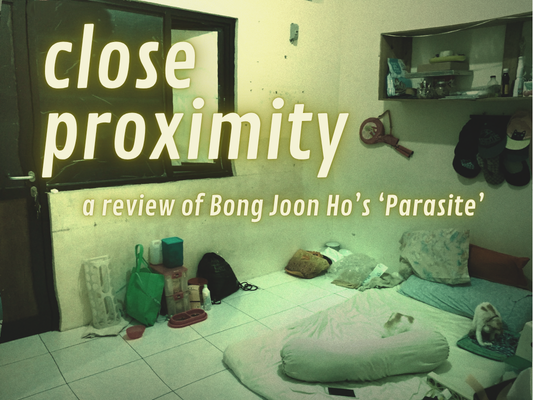
Only a couple of months after my first screening of Parasite, my kontrakan—colloquial Indonesian for rented house, whose spatial quality resembles that of a tenement—was flooded. It was New Year’s Eve 2020 and torrential downpour had been hitting Jakarta for at least 12 hours before floods entered the house. I was stranded at a downtown McDonald’s after a karaoke marathon that spanned six hours and two calendar years, alongside dozens of others seeking refuge from the incessant rain.
I ended up at a friend’s apartment, a high-rise building in South Jakarta, the city’s most swanky, fashionable area, a stark contrast to the 30m² (roughly around 322 sq. ft.) kontrakan, which I shared with my mother, sister, niece, and two Maine Coons. I wouldn’t come home until the evening of New Year’s Day, to the sight of my family hard at work draining the remnants of the floods. In tow were the two storage boxes I had just purchased, as per my sister’s request, to house the “uncovered stuff under mom’s bed,” leaving my savings at a scant $3. So much for stretching out that $25. At least my friend was willing to drive me home on the back of her motorcycle.
Lying down on a folded up mattress later that night, my submerged, frameless bed forcibly tossed to the trash, that fateful scene in Parasite began playing in my head ad nauseam. “I guess this is a taste of poverty,” I thought to myself. At least, unlike the Kim family after their flat is submerged in sewage water, my family and I didn’t have to take shelter in a gymnasium with hundreds of flood survivors and lose our possessions.
“The jobs that these characters take—tutoring, housekeeping, and driving—feature a rare moment where the rich and poor are together in a very private space,” notes Bong in an interview with GQ. The premise of Parasite may be a particular source of fascination for the average American audience; my white American ex, for instance, was befuddled when I told him that it is very common for upper-middle class families in Asia—not unlike my family, before we lapsed into poverty—to have live-in housekeepers and drivers. He reasoned that in America, “that’s some bougie shit.”
Well, it is some bougie shit, especially given how these domestic helpers are typically hired on a word-of-mouth basis—similar to how the Kim clan winds up being hired by the Parks—without any contract let alone legal protection. The informal, nebulous nature of these jobs (which the Kim offspring are offered only after using made-up Western names and faking going to American universities, a testament to how America-centric much of the world still is) leaves a lot of room for power play, the haves leveraging their economic upper hand against the have-nots, the former keeping the latter obedient, subservient, in their place. Staircases, and the movements around them, are the film’s motif after all, a stand-in for the socio-economic ladders that separate both families. More pointedly, Dong-ik, the Parks’ patriarch, notes how he doesn’t like it when people “cross the line,” a subtle—and very Asian, I might add—way to say that those working for him are lucky to be employed at all.
The dynamics between the Kim family and the eventually slain husband-wife duo of Oh Geun-sae and Gook Moon-gwang—how they quite literally jostle for space to remain in the proximity of the Parks’ richesse—mirrors my personal experiences with a handful of other Indonesian immigrants in America. Being an immigrant in the throes of adjusting my status—in Trump’s America, no less—I’m more or less resigned to under-the-table jobs, which are, of course, rife with power imbalance: in Georgia, my passport and visa were detained by an Indonesian business owner, now a naturalized American after serving in the military, during my brief time working at his restaurant; in Alabama, my kitchen manager, a fellow former Jakarta dweller, relentlessly taunted and bullied me for the entirety of my tenure; upon moving to Philly, the owner of a cafe I used to work at (who insisted on only hiring Indonesian immigrants, unwilling to train his workers in English) often physically and verbally abused me, while my co-workers would chide and belittle me within earshot.
Underneath these behaviors lurk an identical message: Don’t cross the line. My legality in America = total power over your survival in this country. Be grateful that I gave you a job in the first place. No complaining allowed. Consider yourself fortunate for being in America, making American money for your family. Except that, unlike them, my main impetus of being in America is precisely to escape my family and do away with all the social conditioning and cultural programming imposed upon the average born-and-raised Indonesian. And yet, it is precisely this conditioning and programming which that ilk happily regurgitates and upholds, two forms of parasite feeding off of each other in the name of the Labor, and of the Capital, and of the Holy Money. Amen.
Parasite does not merely refer to the two families’ mutual leeching off, that twisted, delicate osmosis between control and service, survival and access; in his book Coronavirus Capitalism Goes to the Cinema, Eugene Nulman riffs on Marxist historian Peter Linebaugh’s metaphorical concepts of microparasites (diseases carrying past pandemics) and macroparasites (problematic human actions that cause suffering and inequalities during and following pandemics). Nulman posits that “class solidarity against macroparasites is critical, […] presented in the climax of Parasite that concludes a conflict created by neoliberal self-interest.” As it turns out, none of the fights put up by the Kim family and the Oh-Gook duo yield any victory: the former winds up scattered, the latter is dead, the house—both a symbol of luxury, comfort, and upward mobility and a site of contestation—is simply sold to a family of foreigners, most probably oblivious to its bloodied history, thus maintaining its status and prestige. It’s the only thing that still stands tall at the film’s culmination, unscathed by the murders and crimes committed under its roof. Do we really believe that the Kims end up reunited in the stately residence, all theirs after years and years of bootstrapping and Morse-coding?
Perhaps the fates of Parasite’s habitants would have turned out differently had the Kims stopped short of scheming to oust Gook (seriously, couldn’t the mother just look for a job elsewhere?) or at least continued to allow her to tend to Oh, easily the most damaged microparasite in the movie, who represents the most down-and-out of the world: here’s a super regular Joe who—as per all metrics designed and defined by capitalism—failed in life, with no higher education, no job or career to fall back on, on the run from loan sharks after his business went bust. All these woes contextualize his obsessive worship of Park: part of it may be awe and admiration for how well-off and affluent Park is, part of it is conceivably gratitude for being able to take shelter in his lavish abode (hidden from plain sight as he may be), part of it is also probably desperation and depression for being isolated from the outside world for an extended period of time.
All this leads to how, when threatened by the Kim family’s con, Oh punishes them to protect the source of both their suffering rather than work together with the family to reach their respective goals; logically, their resources are not—or should not be—limited when the Parks get to have unlimited access to wealth and exploit their ilk in the process. Be that as it may, it is difficult to see the forest for the trees when one is caught up in capitalist solipsism to the point where the downcast and disenfranchised collective, typified by the Kims and Oh-Gook, has little to no understanding that it is precisely macroparasites like the Park family and the capitalist systems that cause them to culture ad nauseam. “To free ourselves,” writes Ivo J. Mensch in The Solipsistic Society: from stuckness to collective unfolding, “we’ll have to dismantle our inner machine—the internalised version of the imaginary of late-capitalist modernity that commodifies our attention, steers our behaviour and constrains our imagination.”
Parasite not so much dismantles as it exposes this machine against a backdrop of contrasts—rich vs. poor, fortunate vs. misfortunate, scented vs. smelly—where the microparasites and macroparasites of Parasite propagate and exacerbate, as they navigate their interdependency before a select few’s inevitable demise. Ultimately, the film is a cautionary tale for when self-interest, in lieu of solidarity, underpins a conflict: it’s only a matter of time until the knives are out and parasitic entities get pushed down and rid of. As far as Oscar-winning tour de forces go, it’s a rare gem that sheds a light on the perils of late-stage capitalism, its global reach, and its keening universalism, ironically—or maybe in a way intended to be meta—financed by a Samsung heiress.


