
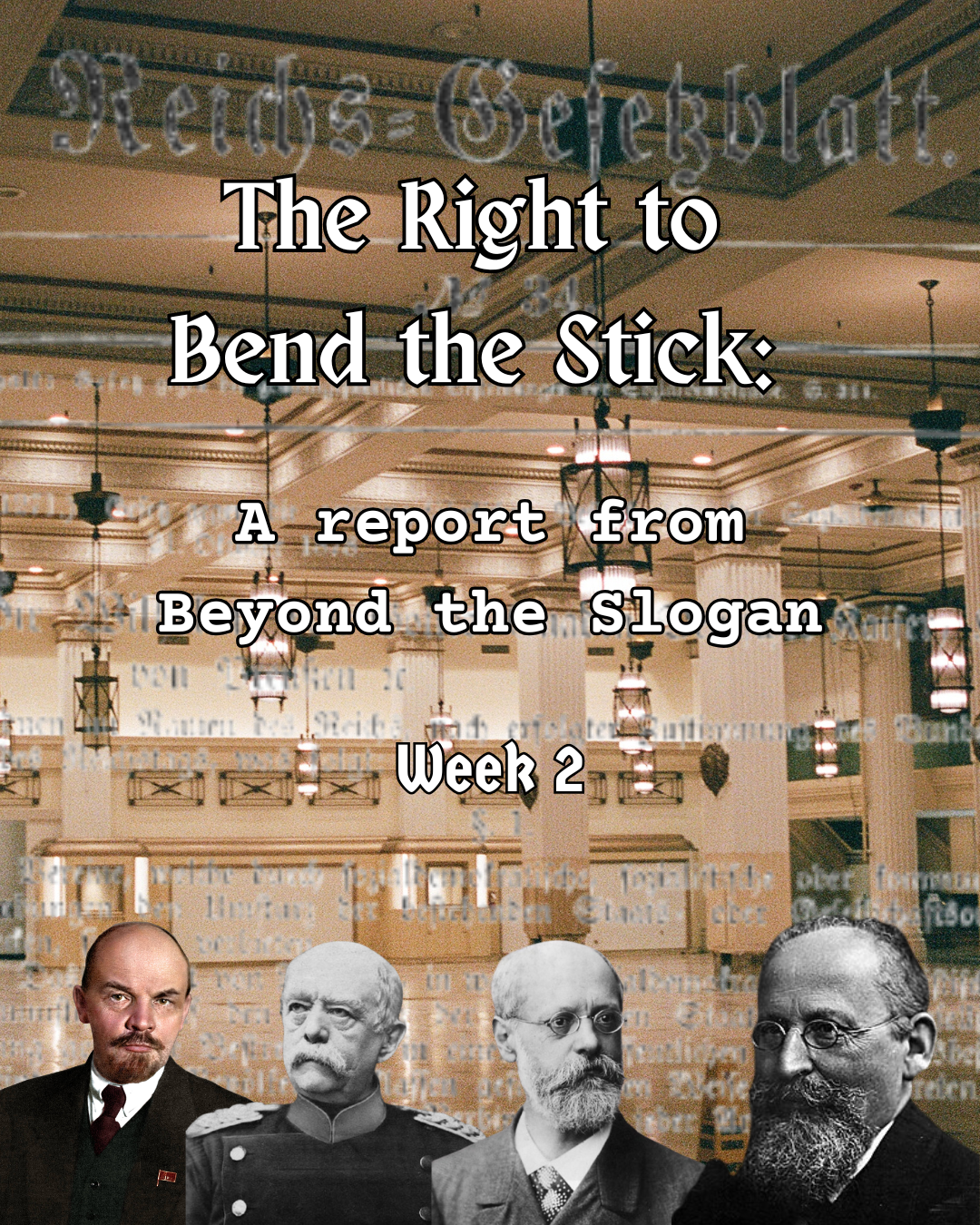
By E.B.
As the crowd gathered in the basement of Wooden Shoe books on Saturday, May 2, and began to chatter, one thing became clear: we had more questions than answers.
The second meeting of Beyond the Slogan discussed Lars Lih’s introduction to “What is to Be Done?” by Vladimir Lenin. As scholars, we were excited by the abundance of topics to cover. The assignment of the week had been to read Lih’s introduction to his interpretation. Lih opened his argument about Lenin’s work with concepts that made us eager to learn more, but wary to decide just yet if we agreed or disagreed. Lih’s intention for the introduction, we determined, was to set up his argument for not only the instrumental nature of WITBD in radical literature, but to offer a new perspective on translation that in the past has been pushed to the side.
Before we dove too far into the details of these arguments, we took time to frame the historical context of when WITBD was written. Distinctively, WITBD was written during a time of scathing, post-war interpretations. The facilitator of the week broke down some of the context overlooked by Lih in his introduction. Most important perhaps was Lenin’s steadfast allegiance to the ideal of the German Social Democratic party. We distinguished that Lenin leant heavily into “Erfurtian” ideas of social democracy, which ties him to a party that views itself much differently than the social democrats of our modern U.S. context. The approach of the Erfurtian/German Social Democrats was non-revolutionary and within a welfare state; they did not believe there was an inherent need for a mass socialist movement, focusing instead on moving their vision through the machinery of the state to accomplish party goals. One specific point that caught our attention about the environment that birthed most Erfurtian thought: it had a populace that was educated and industrialized. To the resistance, responding to the monarchy by seizing state powers was attainable and therefore achievable. The Erfurtians were also operating with relative political freedom.
It is worth noting that this political freedom was used as a weapon in allowing for the survival of the Social Democratic presence in Germany. With help from the week’s facilitator, we broke down a rough timeline of German unification and its impact on Lenin’s context. After the end of the Franco-Prussian war, Otto von Bismarck oversaw the creation of the German Empire before being awarded Chancellorship under the king of Prussia. Under the classical interpretation, this role allowed Bismarck to dictate policy and made him responsible for the unification of Germany.
At the conclusion of the unification plan, Bismarck held “equal power” with Germany’s parliament, who were not able to propose laws, only vote on them; this continued to leave the power to dictate policy in the hands of solely the state. There was also a communist presence in the Social Democratic Worker’s Party (SDAP) and the General German Worker’s Association (ADAV). In 1875, the SDAP, a group heavily influenced by Marxism, and the ADAV, who focused more on state socialism, united at the Katha congress to form the Social Democratic Party of Germany (SDP).
By 1878, Bismarck proposed and parliament passed the “Law against the Publicly Dangerous Endeavors of Social Democracy,” better known as simply the “Anti-Socialist Law.” The law effectively banned all socialist, socialist democratic, and communist associations and publications. Men with parliamentary power retained political freedom, since the law did not have any electoral impact. This allowed for those with socialist democratic backgrounds to run as independents and speak with parliamentary immunity. Despite severe state repression, a combination of propaganda, organization, demonstration, and legal battles was still possible. By 1890, a surge in Social Democratic voting saw the law lifted.
Understanding the ability of the SDP to gain control of state power gave us perspective on why Lenin held its values closely. However, it left a sizable gap between 1890 and the publication of What is to Be Done in March of 1902. There were still pieces of the puzzle we wanted to ponder in order to understand the full picture of Lenin’s context and Lih’s interpretation.
We turned to the 1891 Erfurt Congress, which was a consortium among Social Democratic leaders to determine what exactly was to be done now that they had regained legal status. This meant discussing the Erfurt Program, the official party platform, penned primarily by Karl Kautsky. It was Kautsky’s contributions that we spent the most time discussing, as they enlightened us on the beliefs central to any work of Lenin.
Kautsky divided the program into the “maximum” program and the “minimum” program. These programs allowed for the distinction between long-term vs short-term goals of the platform. The “maximum” program focused on long term goals concerned with the state; the “minimum program” prioritized immediate laws that could be passed for the cause.
The Erfurt Program also marked the first time that overthrowing the capitalist system was enshrined as a major goal in a party document. The architects of the program believed that it was the responsibility of the party to bring the struggle of the working class within its ranks. To do this, the program suggested conceptualizing Social Democracy as a merging of socialism and the workers’ movement; they believed that the laboring classes would always need guidance from the greater proletariat. However, the greater proletariat would not exist without the laboring classes.
We were almost back in the realm of Lih’s interpretation after this discussion and turned our pursuits towards Bernsteinism. We were finally relatively close time-wise to the publishing of “What Is to Be Done”; the pieces were coming together – for now. The discussion became lively as we labeled Eduard Bernstein, one of the first serious critics of the Erfurt Program, the “OG reformer.” We took time to understand the basics of reformist ideology; that “Bernsteinists” wanted to work with the capitalist system instead of overthrowing it.
Of specific interest was two beliefs reformists of this time held: that Lenin believed in the “forcible conversion” of the working class and their distaste for any sort of “vanguardism” within the socialist movement. We pulled directly from Lih’s work a quote from Adam Ulam, a former political science professor at Harvard University:
“Why, then, is Bernstein a ‘revisionist’ and Lenin an ‘orthodox’ Marxist? Because Bernstein believes in the workers’ party following the inclinations of the workers and bowing to the inherent labourism of the industrialized worker, whereas Lenin believes in forcible conversion of the worker to revolutionary Marxism.”
In other words, Bernstein believed that the “Vanguards,” or intellectual class of the Social Democratic Party, intervened inappropriately. We disagreed with this notion, discussing how the activists of SDP would have provided a framework or “theoretical struggle” to the laboring classes and “representatives” of SPD within its rank. We thought that the belief also overlooked the fact that the members of any Vanguard would come from the laboring classes.
Having finally spent what we deemed enough time understanding the context in which “What is to Be Done” was written, we set our sights on Lih’s interpretation. We followed his fascination with those who claim WITBD caused the break within in the SPD and recapped some popular critiques that come with the traditional “academic” and “activist” interpretations of the text advanced by Lih.
One particular idea of Lih’s we focused on was that Lenin’s tone is typically interpreted as frustrated with the working class and reflecting on what must be done with them. Additionally, Lih believes that trying to find meaning behind of the word “spontaneity” is a fruitless effort. Besides referencing Lih’s footnote that he believes the word truly mistranslated, we agreed with his argument that the actual passages that used “spontaneity” were short and few. We pondered Lih’s assertation that a “Vanguard,” or selected intellectual leaders, already existed within the Social Democratic Party of Germany. We discussed the fact that it might have already existed, but perhaps not labeled yet. Surely, the concept at the core of vanguardism was not new.
A term that was unfamiliar to some but used often in the reading was “polemic.” We took time to understand that engaging in polemics meant making controversial arguments to specific opinions. Here, we discussed briefly Lenin’s notion that reformists reacted poorly to polemics. He believed, as the Russian proverb goes, they “rather a bad peace than a good quarrel.” Our consensus was that writing off polemics as a political tool would not be true to the ideals of Marxism, as it is driven by struggle. We agreed that polemics are a central part of political discussion. This connected nicely, someone noted, to our first discussion. We’d discussed being excited to use “What is to Be Done” to foster conversation with others; we sought to find a theoretical struggle to tie to our pursuits.
We moved next to what Lih described as the academics’ classical interpretation of WITBD. A typical academic scholar may believe that Lenin was a gloomy pessimist of sorts, worried about the working class and perhaps even labeling them as a problem. In that scenario, WITBD would have been an attempt by Lenin to galvanize an inactive sect. Lih offered that Lenin instead saw an organic movement of a motivated working class that wanted change. We took this as Lenin wanting to spread the “good news” of socialism, and instead of sitting down to speculate what is to be done about a problem, he was wondering where the movement would lead.
This led into a wonderful foray of our own interpretation of “good news socialism”; to us, this meant going to others with our ideas knowing that people would be ready to organize with us. Organization is already happening – it is up to us to join together as a larger collective. We wondered if Lih was offering his own “good news” interpretation, or if he was simply borrowing from Kautsky or Lenin’s. For a moment, we circled back to an earlier concept of the “legal” existence of socialism before and after the Erfurt Congress. We thought it important to consider how operating under the Anti-Socialist Law would have influenced Lenin’s writing of What is to Be Done. This led to us to understand that Lenin could have recognized the existence of an underground movement.
Briefly, we discussed the “activists” interpretation advanced by Lih and its connection to “stick bending,” which we noted Lenin was often accused of. However, we agreed that while he may bend the stick, he always returned it to its original position. Or, we joked, he would claim that he never bent it too far.
We thought it interesting that Lih seemed to believe that the common socially democratic view in Western Europe was fatalistic. This led to us to dissect the concept of “economic fatalism,” or the idea that workers are only capable of focusing on the economic struggle. We expanded on this thought by proposing that perhaps the “winning” of the economic struggle would still allow for us to accomplish socialism.
As we wrapped up the general discussion of the reading, we turned back to a central question: why are we reading this? Someone noted that if “What is to Be Done?” is about a thrust for social democracy to win political freedom, it may not be fully applicable to our context. That said, we pondered if, in theory, we have political freedom, what are we looking for in the text? Briefly we returned to the concept of “good news socialism” and discussed how it connected with our need for security within our movement. We know our actions are monitored, so how does operational security coexist with bringing the “good news” to our community? At this, we questioned how Lih or Lenin would have defined “political freedom.”
First, we recognized that our political repression is vastly different than that of Lenin’s context. We commented on the fact that much of it comes from internal forces, such as structural racism and misogyny, and having to fight the machine of the U.S. government. Because of this, we decided that we view political freedom as more of a spectrum than something final. It was worth noting that we would not be immune to punishment if other parties perceived our actions as threats.
Returning to a point from earlier in the discussion, we refocused on our view that while the work of the working class may be different than that of a supposed “Vanguard,” it is still present. We spoke briefly of the upsurge in warehouse fires. Regardless of the view of previous scholars, we affirmed our belief that organization, whether it happens in the rooms we are in or not, is important to the cause.
The next meeting of “Beyond the Slogan” will take place on Saturday, May 16, from 1-2:30pm at Wooden Shoe Books. Those interested in partaking may find the curriculum linked here.
Credit to Tyler for photo in header image.


